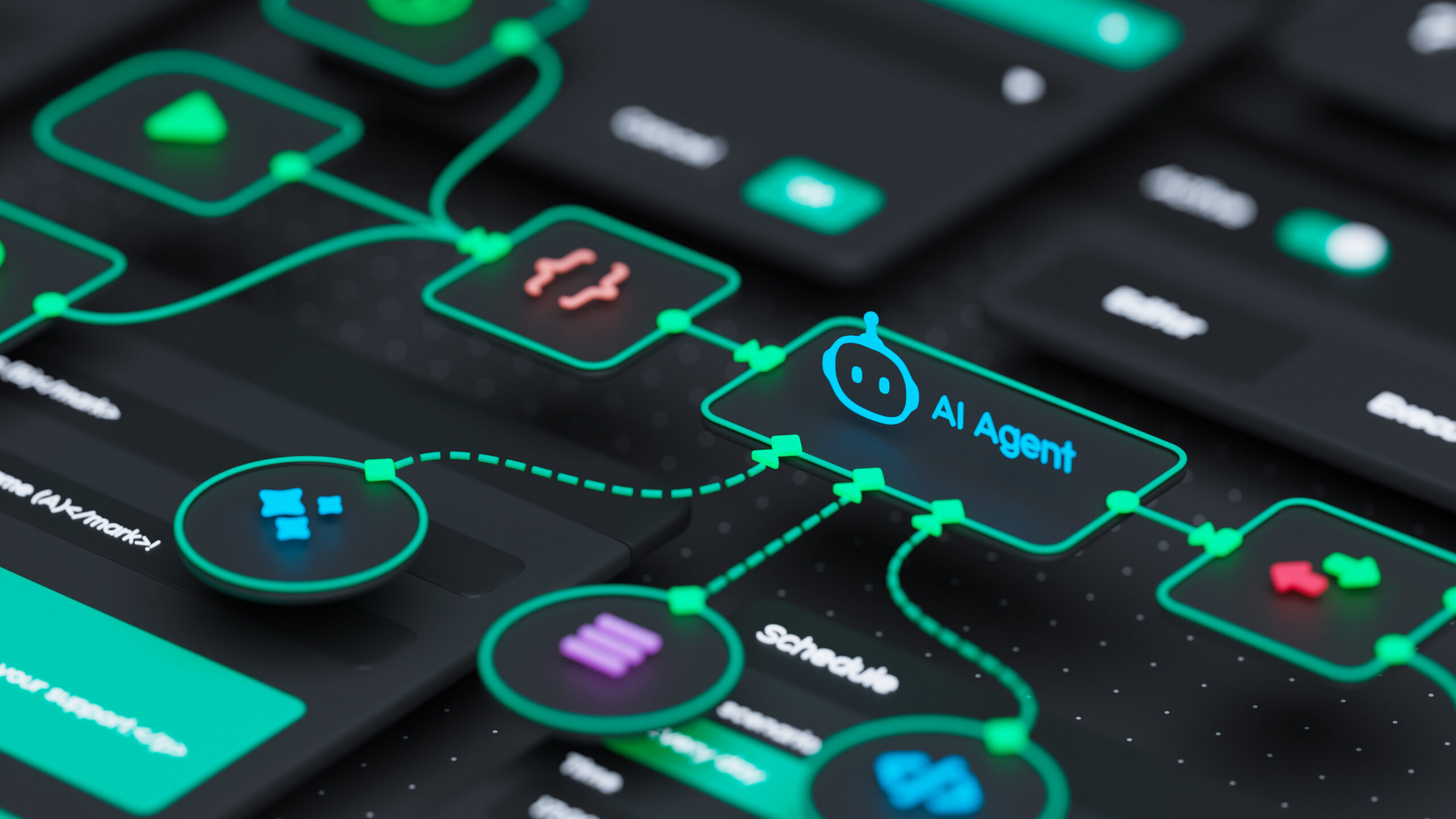
At IQ-EQ, our dedicated AI team is developing intelligent solutions that will transform how we serve clients. With a team of eight AI developers, four business process designers and an international leadership team, we’re building capabilities that adapt to our unique business needs. Traditional systems struggle with our non-standard inputs and constantly changing regulatory landscape, but AI thrives in this environment.
Chris Robinson, our Group Chief Technology Officer, explains more…
Q: What’s the focus of IQ-EQ’s AI strategy?
We’re working across three key areas: digitisation, AI-enabled workflows and AI agents.
Over the past two decades, our industry has evolved from paper-based to digital systems. Here at IQ-EQ, we’ve built our digital foundation, implemented digital workflows, rule-based robotic process automation, etc. And we will continue to progress this.
When it comes to AI-enabled workflows, this is where things get interesting. We’re embedding intelligent capability into every aspect of our operations. These aren’t just automation tools; they’re intelligent systems that understand context and nuance. They can accurately identify patterns across vast amounts of data, track anomalies and provide insights in negligible duration compared to weeks when done manually.
And then there’s our work on AI agents – the most exciting and fascinating operational enabler to date. What is an AI agent? Imagine an AI system that doesn’t only follow predetermined steps but thinks through and plans how to complete a complex task and, most importantly, adapts when it encounters a problem or obstacle. If one approach doesn’t work, it’ll try another one. It’ll learn from the experience, improving with each iteration.
It’s not about incremental improvements anymore – we’re developing systems that could multiply our people’s capabilities three to five times over.
Q: How is your team approaching AI development?
There are two core types of AI platform. First, there are the publicly available, commercial solutions like ChatGPT. These AI agents will help you but they’ll also take data from you. Alternatively, you can download an AI model and develop and train it yourself, offline.
We like to compare this choice to playing with a neighbour’s puppy versus adopting your own puppy and rearing it yourself. At IQ-EQ, we’re raising our own puppy! We are building and training our own AI models rather than rely solely on commercial solutions, giving us far greater control.
With this approach, we maintain complete control of data and security, which is crucial for our industry. We use our AI platform, which we’ve named IQEQ.AI, for anything involving “3 Cs” sensitive data – i.e. data that relates to compliance, to our clients, and to our colleagues. Whatever the new AI model is, we download it, unplug it from the internet, test and fine-tune it before rolling it out.
Q: What makes your AI approach different from others?
Unlike others who might be focusing on theoretical AI applications, we’ve already launched real solutions and have a sizeable team dedicated to keeping us ahead of the game. In 2025 alone we had 50 projects planned for roll-out. For example, our IQ Minutes and Infinity Extractor tools are the first stages of our AI CoSec agent, with both now in active roll-out.
We’re categorising our AI development into four pillars – Agentic AI, Extraction, Reporting, and Enterprise Service Management – creating a comprehensive ecosystem rather than isolated solutions. We’re also using a balanced ‘4B’ strategy – Build, Borrow, Buy and Bridge. Each approach has specific applications based on data sensitivity.
For our most confidential client data, as mentioned, we build proprietary solutions. For less sensitive needs, we leverage commercial AI or create bridges using low-code tools. This framework ensures maximum data security while delivering immediate results and long-term value.
Q: How are you focusing on client needs?
Our AI initiatives directly address client pain points. For example, our RegCom ChangeTracker automates the collection and analysis of regulatory information from hundreds of sources, while our Fill Extract AI tool streamlines document processing for corporate services. These tools not only make fundamentals faster and better for clients, but also free our skilled professionals to focus on strategic activities that add greater value.
Q: How does this benefit clients while protecting their data?
Our clients trust us with their sensitive data. Through stringent security measures and rigorous testing, we ensure this trust extends to our AI solutions. We’ve developed clear ethical AI policies and processes, adhering to international standards, and I’m delighted to say we’ve now achieved the ISO 42001 certification, the global benchmark for responsible and trustworthy AI management systems.
This accreditation provides us with a robust structure for AI governance, ethics, security and continuous improvement and supports our long-term ambition to embed responsible AI across every part of our business, while strengthening the trust our clients place in us and our services. For us, the human-to-human trust remains central, with AI enhancing what we deliver rather than replacing it.